
Most golfing beginners in Burlington, Ontario, pick up a club with the best intentions. They watch a few YouTube golfing videos, head to the range, rent equipment, and start swinging. The problem is that nobody is watching them.
Golf habits form quickly, and without feedback, a beginner may repeat the same mistake for months. The body starts to trust what feels normal, and that makes wrong movements harder to fix later.
A qualified coach changes that completely by seeing what you cannot feel, corrects what you cannot see, and builds your game on a solid basis from day one.
In this blog, we discuss seven mistakes that new Burlington golfers often make and how a good coach fixes them to help you start your golf journey the right way.
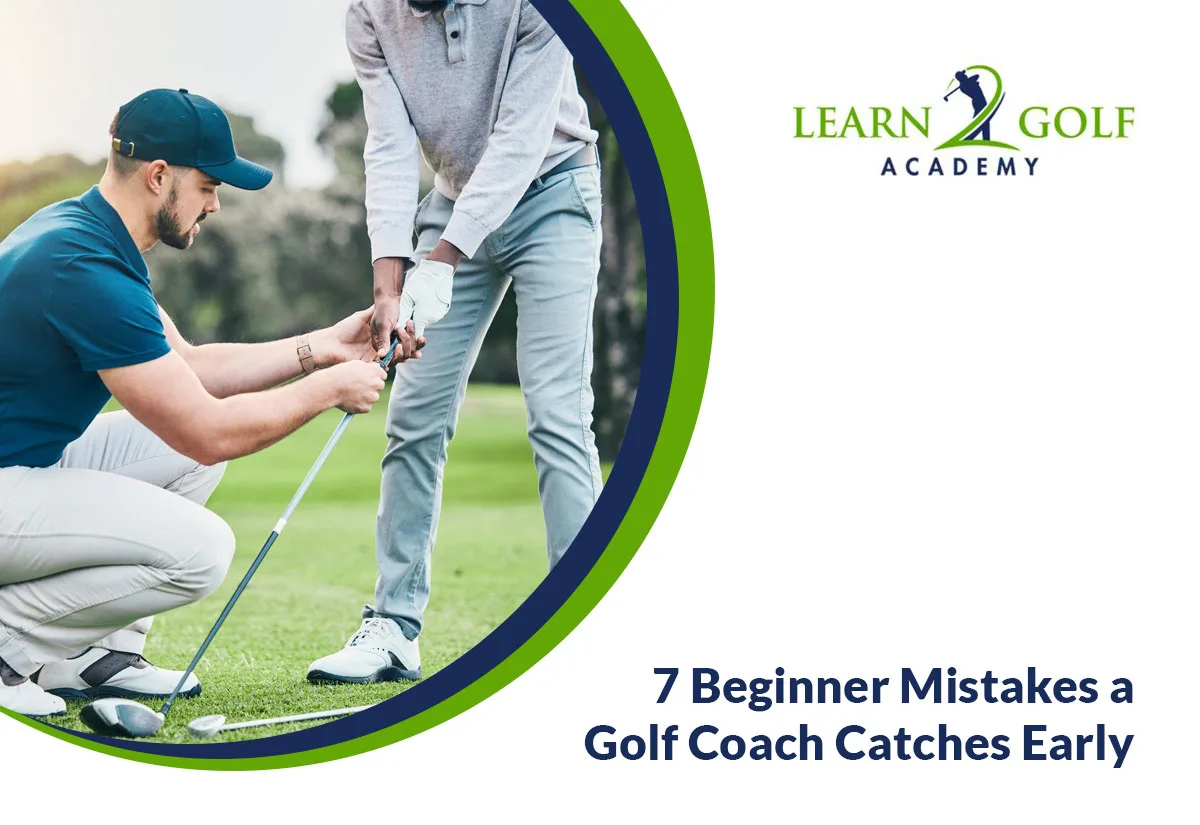
These mistakes may seem small at first. To an untrained eye, they are easy to miss. That is what makes them risky, and repeated often, they can shape your whole swing.
Most beginners grip the club as if it might slip away. That tight grip feels like the right way to stay in control of the swing. In reality, all that tension travels straight up through the wrists and arms, killing any chance of a smooth, clean strike.
A coach spots this immediately. The correction is simple in theory, but hard to feel on your own. The grip pressure needs to be firm but relaxed, like holding a tube of toothpaste without squeezing out the paste. A proper grip affects every other part of the swing. Fix it early, and many other problems fix themselves along with it.
A Burlington beginner working through private golf lessons will hear about grip in the very first session, because that is where good instruction always starts.
Beginners often stand too far from the ball. To reach it, they stretch their arms out at the start, which changes the natural path of the swing. That stretched position causes the club to skim across the top of the ball instead of making solid contact underneath it. The result is a weak shot that goes low, runs along the ground, and travels nowhere near as far as it should.
A coach looks at your setup before the swing starts. Proper distance lets your arms hang naturally from your shoulders. Your elbows should have only a slight bend. Your posture also affects balance from start to finish. When the distance is right, the club can return to the ball more easily. This detail is hard to learn from a video, as a camera cannot always show the angle your body needs.
This one is very common among adults learning golf later in life. Instead of rotating the hips through the shot, beginners sway their bodies sideways. The result is inconsistent contact and a complete loss of power. It also unnecessarily strains the lower back.
A coach watches the lower body the whole time. The hips should turn, not slide. For instance, a good drill for this is placing a club along the outside of your back foot and making sure your hip never pushes past it during the backswing. This correction takes minutes to explain but months to fully ingrain. Starting it early means your body builds the right pattern before the wrong one gets comfortable.
Almost every beginner makes this mistake. It is natural to want to see the ball fly. However, the problem starts when you look too soon. Even a small head lift can pull your upper body out of position, and the club then reaches the ball poorly.
A coach teaches your eyes to stay down through contact. The ball will still be there after impact. You need to hit it first. Bad habits are hard to break once they are wired into muscle memory, which is exactly why catching this in the first few sessions makes such a difference.
A good instructor gives you a simple focus point past the ball. This keeps your head steady without making the swing feel stiff. It also gives your mind a clear task.
Many beginners keep their weight on the back foot too long. It feels like staying behind the ball, but it causes a scooping motion at impact. That produces two poor contact errors. A fat shot is when the club hits the ground before the ball. A thin shot is when the club clips only the top of the ball. Both produce weak, short shots. That soft contact is the clearest sign that your weight transfer needs work.
Weight should shift from the back foot to the front foot as the club comes through. A coach builds this into your swing from the start. For instance, a simple drill is to finish with your back foot on its toe and your front foot fully grounded. This teaches the body what a complete weight shift feels like.
Golf lessons for Burlington adults focus heavily on this area because weight transfer is one of the biggest separators between a beginner and a confident player.
Every beginner wants more distance. That goal often leads to swinging too hard. Balance disappears, timing breaks down, and contact gets worse. A swing that feels powerful can send the ball nowhere useful. Distance becomes harder, not easier.
A coach slows down the process. Remember, golf power comes from technique, not force. The club must move on the right path first. Clean contact must happen before distance improves. A swing at seventy percent effort often works better than a full-force swing. This can feel wrong until you see the ball flight.
This is where a qualified coach comes in to give you feedback. Solo range practice cannot always do that. Core and hip mobility are some of the useful exercises to do alongside your golf lessons. They help you build controlled power, not rushed effort.
New golfers often care most about driving, which is hitting the ball as far as possible off the tee. In comparison, chipping (the short, low shot played near the green) and pitching (a slightly longer soft shot used to land the ball close to the hole) feel less exciting. Here, putting (rolling the ball along the green and into the hole) feels almost too simple to practice, so beginners often skip all three.
A coach balances this learning from the start. The short game makes up more than half of all shots in a typical round. Furthermore, chipping and putting are easier to learn early because the movements are smaller and more controlled. Building short game skills alongside your full swing means you become a complete player faster. Beginner golf lessons for Burlington golfers cover all parts of the game and give students a much clearer picture of what golf requires.
Knowing the mistakes is one thing. Having the right structure around you to fix them is another.
Golf lessons for Burlington adults at Learn 2 Golf Academy are built around the individual. Every student has a different body, a different background, and a different set of habits walking in. Private coaching means the instructor is never splitting attention between multiple students. Every drill, every correction, and every piece of feedback is directed at you. That level of attention is what makes real change possible, especially for adult learners who have already built some patterns on their own.
Learn 2 Golf Academy offers structured programs for beginners, juniors, seniors, and women. Each program accounts for physical differences, learning pace, and goals.
A beginner does not need the same instruction as a mid-handicap golfer trying to break eighty. The academy builds the lesson plan around where the student is, not where a generic curriculum assumes they should be. That fit between student and program is what keeps improvement consistent rather than random.
Many beginners delay booking a lesson because they feel they are not good enough yet. That thinking keeps a lot of people on the sidelines far longer than necessary.
Learn 2 Golf Academy believes in making golf approachable for anyone walking in for the first time. There is no pressure to perform and no assumption that you already know the basics. Adult learners can benefit from an environment where asking basic questions is normal and expected. When a student feels comfortable, learning happens faster. Confidence and technique grow together, and that combination is what turns a hesitant beginner into someone who actually enjoys the game.
Golf is a game where the smallest details matter most. The mistakes covered here are common, correctable, and completely avoidable with the right guidance in place from the beginning. Golf lessons give Burlington beginners the feedback, structure, and expert eye they need to build real skills rather than comfortable habits. Learn 2 Golf Academy provides that kind of grounded, personalized instruction for golfers of every age and background. The best time to start right is always before the wrong patterns have time to settle in.